
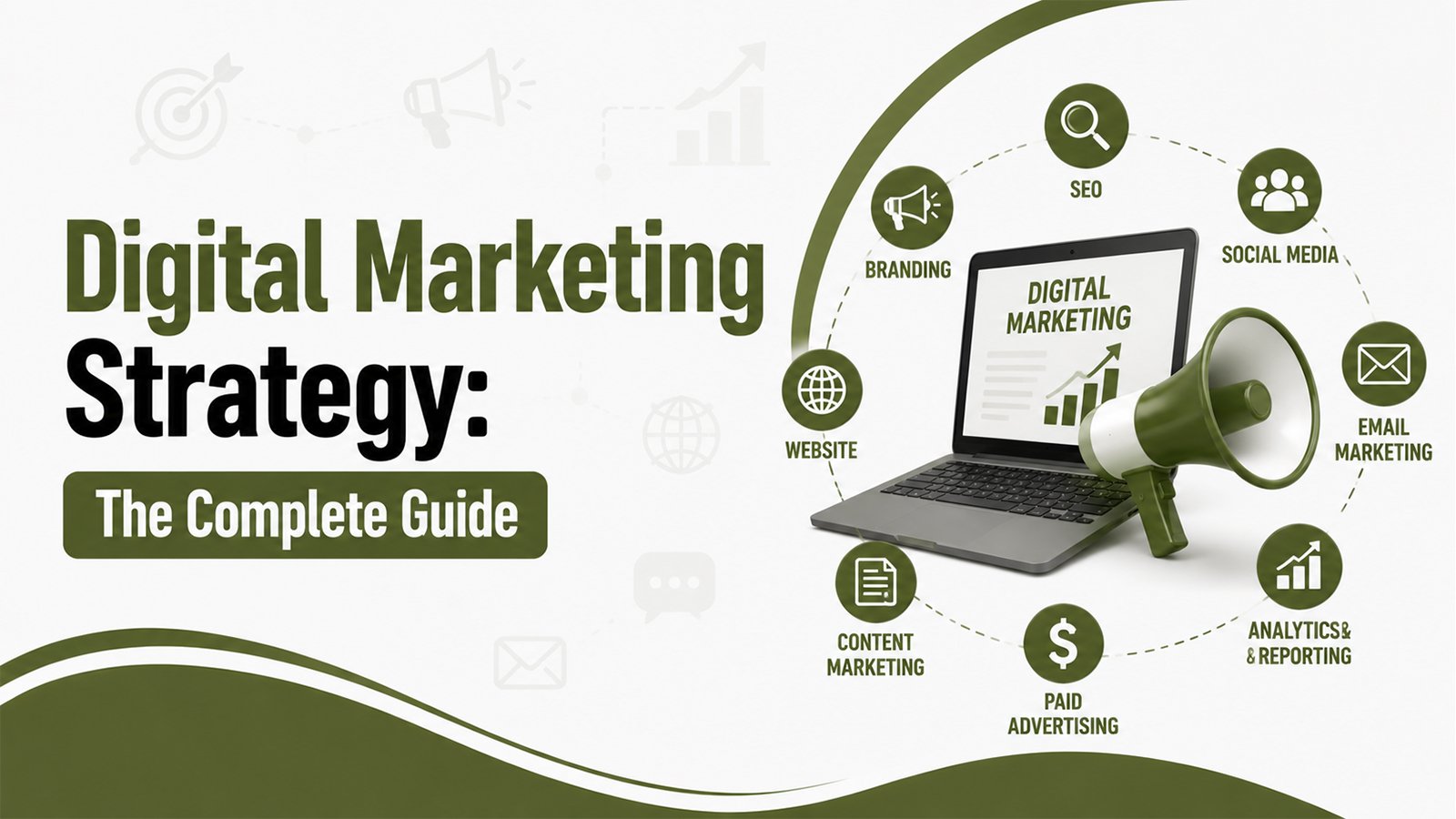
Learn how to build a successful Digital Marketing Strategy using SEO, Meta Ads, Google Ads, and Appointment Booking to generate leads, increase conversions, and grow your business.
Digital Marketing Strategy for Business Growth
How SEO, content, Meta Ads, Google Ads, and appointment booking come together into one predictable system for leads, conversions, and revenue.
A digital marketing strategy is a structured plan that helps businesses attract the right audience, generate qualified leads, convert prospects into customers, and increase revenue through online marketing channels — replacing random marketing activity with a predictable system that guides people through every stage of the buying journey.
Tactics vs. Systems
Many businesses struggle online because they chase tactics instead of building systems — running ads without proper tracking, publishing content without a plan, or investing in SEO without understanding customer intent.
Without a strategy
- Marketing becomes inconsistent
- Ad budgets are wasted
- Lead generation is unpredictable
- Revenue growth slows down
With a strategy
- Goals become clear
- Performance becomes measurable
- Acquisition becomes predictable
- Growth becomes scalable
Companies that follow a structured approach consistently outperform competitors, because every marketing activity supports one larger business objective.
Understanding the Customer Journey
Before building a strategy, businesses need to understand how customers actually make purchasing decisions. Most move through five stages, and a strong strategy delivers the right message at each one.
Setting Clear Business Goals
Every successful strategy starts with clearly defined, SMART goals — Specific, Measurable, Achievable, Relevant, and Time-bound. Clear goals make progress measurable and decisions easier.
Website Strategy
A website is the foundation everything else builds on — effectively a 24/7 salesperson for the business when it’s done right.
- Loads quickly
- Works perfectly on mobile devices
- Clearly explains services
- Builds trust through testimonials and reviews
- Includes strong calls-to-action
- Uses conversion-focused landing pages
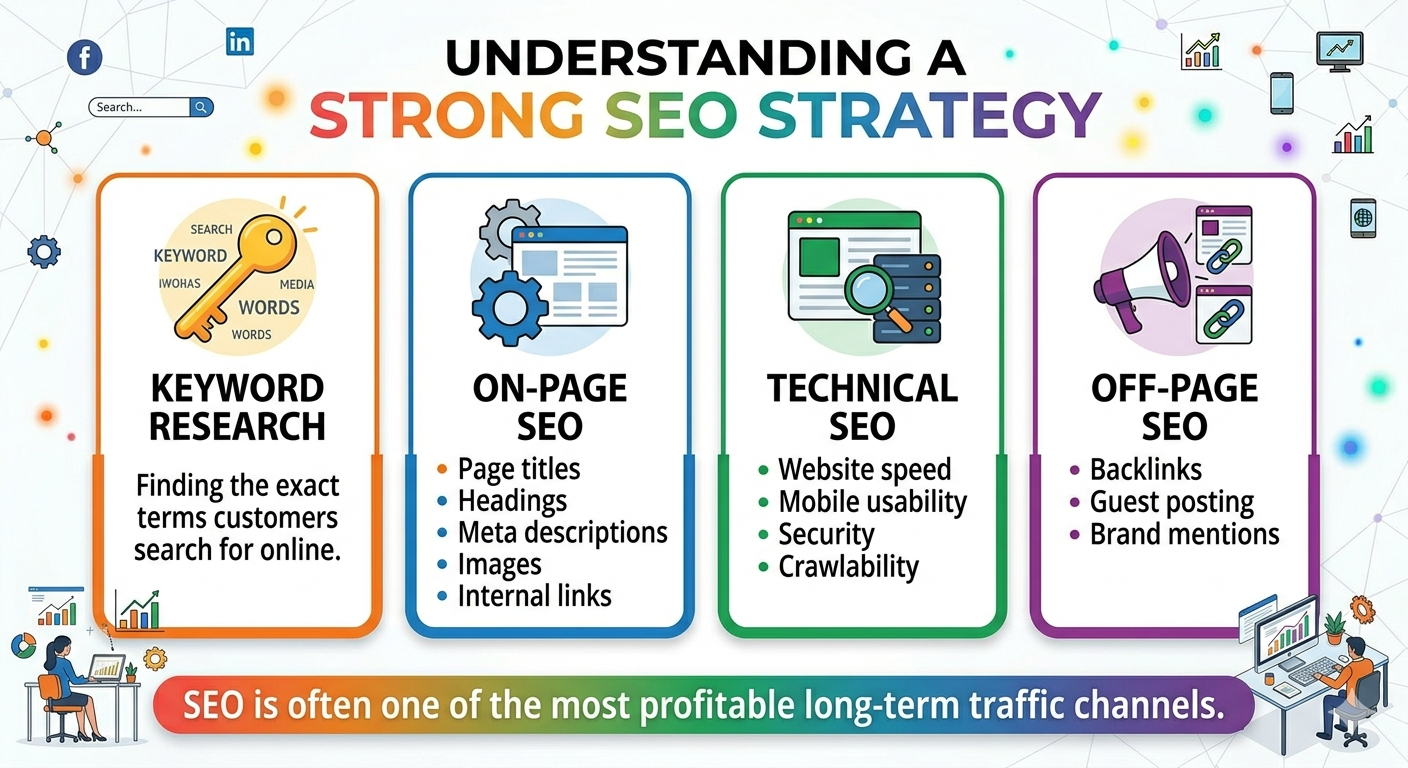
SEO Strategy
Search Engine Optimization helps businesses attract organic traffic from Google, and is often one of the most profitable long-term channels available.
Keyword Research
Finding the exact terms customers search for online.
On-Page SEO
Optimizing page titles, headings, meta descriptions, images, and internal links.
Technical SEO
Improving website speed, mobile usability, security, and crawlability.
Off-Page SEO
Building authority through backlinks, guest posting, and brand mentions.
Content Marketing Strategy
Content marketing helps educate potential customers and build trust by solving real problems and answering real questions — through blog posts, guides, videos, tutorials, case studies, and infographics. High-quality content supports SEO, builds brand authority, and generates leads.
Lead Generation Strategy
Lead generation is the process of converting visitors into potential customers, typically through SEO, Google Ads, Meta Ads, LinkedIn marketing, email marketing, and social media. Lead magnets — free audits, templates, checklists, and guides — encourage visitors to share their contact information.
Lead Qualification Strategy
Not all leads are ready to buy. Qualification helps businesses focus on the strongest prospects by evaluating budget, needs, timeline, and decision-making authority — improving sales efficiency and conversion rates.
Appointment Booking Systems
Appointment booking bridges the gap between marketing and sales. Online booking calendars, automated reminders, confirmation emails, and qualification forms reduce friction — increasing booked meetings and reducing no-shows.
Meta Ads Strategy
Meta Ads (Facebook and Instagram) provide fast access to targeted audiences. Successful campaigns rely on audience research, high-quality creatives, strong offers, conversion tracking, and retargeting — which is especially effective because it reaches people who have already interacted with the business.
Google Ads Strategy
Google Ads reach customers actively searching for solutions right now. The key elements are keyword targeting, ad copy optimization, landing page relevance, and conversion tracking. Properly optimized, Google Ads can generate highly qualified leads consistently.
Analytics and Tracking
Data is essential for improving performance over time. Businesses should track website traffic, conversion rates, lead quality, cost per lead, and revenue generated — using tools like Google Analytics, Google Search Console, Google Tag Manager, and the Google Ads dashboard.
Tracking doesn’t just measure what happened — it points directly to where the next opportunity for growth is hiding.
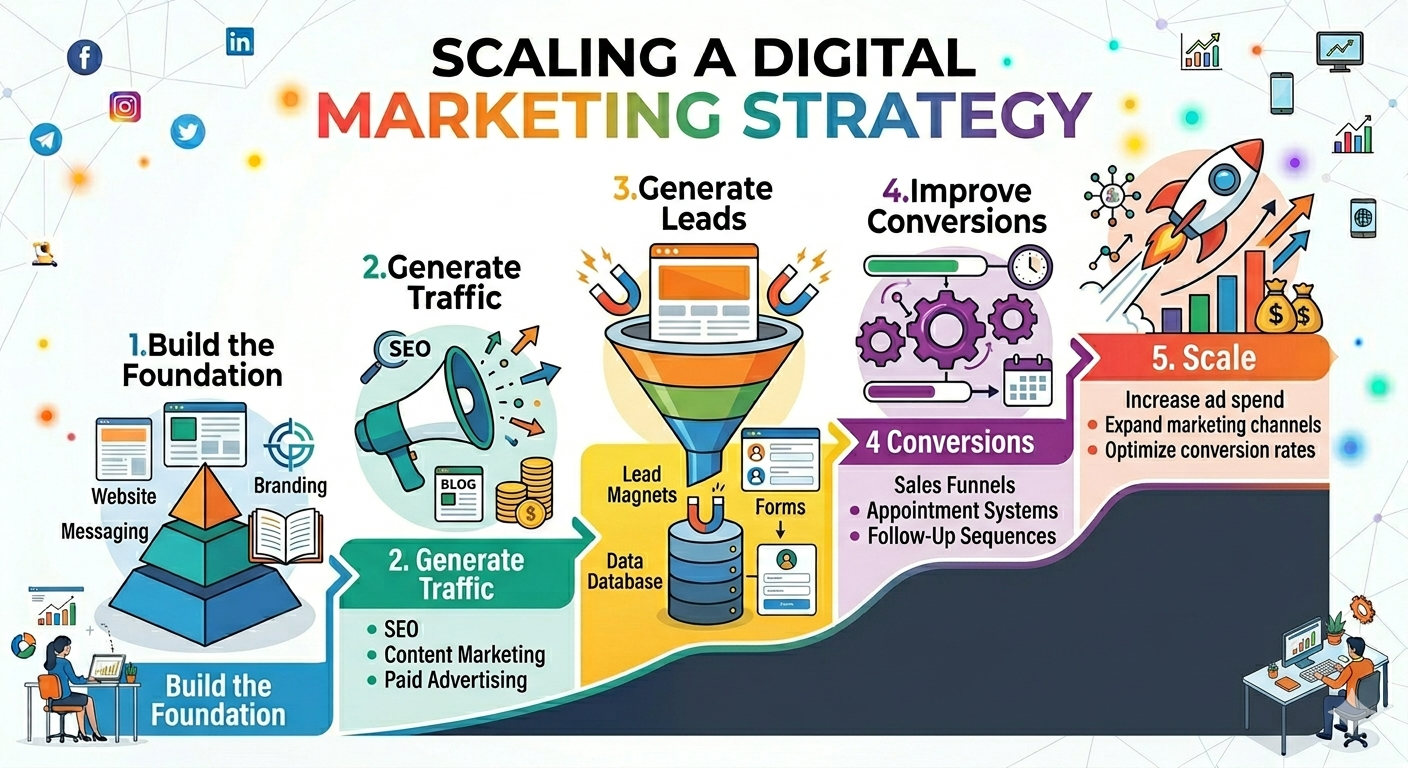
Scaling a Digital Marketing Strategy
Growth tends to follow five predictable stages, each one building on the last.
Build the Foundation
- Website
- Branding
- Messaging
Generate Traffic
- SEO
- Content Marketing
- Paid Advertising
Generate Leads
- Landing Pages
- Lead Magnets
- Forms
Improve Conversions
- Sales Funnels
- Appointment Systems
- Follow-Up Sequences
Scale
- Increase ad spend
- Expand marketing channels
- Optimize conversion rates
Final Thoughts
A digital marketing strategy is far more than a collection of tactics — it’s a complete framework for attracting the right audience, generating qualified leads, booking appointments, and increasing revenue. By combining SEO, content marketing, Meta Ads, Google Ads, lead generation, lead qualification, appointment booking, and analytics, businesses build a predictable growth engine that delivers results long-term.
The businesses that win online aren’t necessarily the ones with the biggest budgets — they’re the ones with a clear strategy, consistent measurement, and the discipline to keep improving their systems over time.