

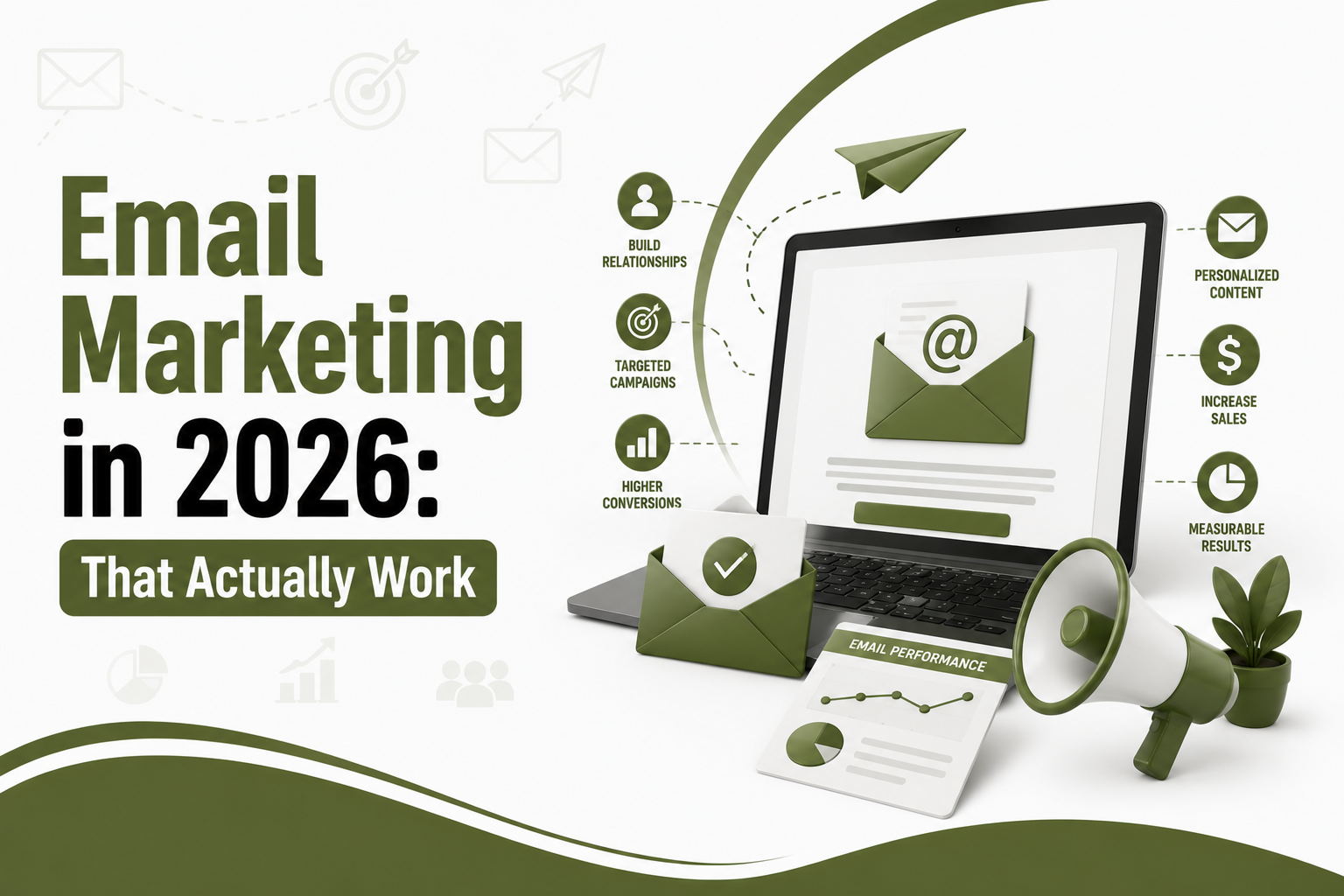
Learn what email marketing is, why it still delivers the highest ROI in 2026, and how to choose the right email marketing software, platforms, and campaigns for your business.
Email Marketing in 2026: That Actually Work
Learn what email marketing is, why it still delivers the highest ROI in 2026, and how to choose the right email marketing software, platforms, and campaigns for your business.
If you run a business today and you’re not using email marketing, you’re leaving money on the table. Every year, someone predicts that email is “dying,” and every year it proves them wrong. In 2026, it’s still one of the highest-return digital marketing channels out there, and businesses of every size — from small local shops to large exporters — are using it to build relationships, generate leads, and drive repeat sales.

In this guide, we’ll break down what email marketing actually is, how campaigns work, which software and platforms are worth your time, and where this channel is heading next. Whether you’re brand new to it or looking to sharpen an existing strategy, you’ll walk away with a practical roadmap.
01What Is Email Marketing?
Email marketing means sending targeted messages straight to a subscriber’s inbox to promote products, share updates, or build long-term relationships with customers. Unlike social media, where an algorithm decides who sees your content, this gives you direct, unfiltered access to your audience. You own your list — no platform update can take that away from you.
At its core, it runs on a simple idea: people give you permission to email them, and in exchange you send them something they actually want. That permission-based structure is what separates real email marketing from spam, and it’s also why it keeps outperforming other channels on ROI.
02Why Email Marketing Still Matters in 2026
Despite the rise of social media, SMS, and AI chat platforms, email keeps delivering an exceptional return — many studies put it somewhere between $36 and $45 back for every dollar spent. That’s a return that’s hard to match anywhere else.
A few reasons it’s still essential:
03How Does Email Marketing Work?
A solid strategy usually follows a simple path: build a list, segment your audience, create valuable content, measure results. Businesses collect addresses through sign-up forms, lead magnets, or checkout pages, then use software to organize subscribers by behavior, interest, or purchase history.
Once segmented, they design campaigns — welcome sequences, promos, newsletters, automated drip sequences — and send them through whichever platform they’ve chosen. Then they track opens, clicks, and conversions to keep improving.
04Types of Email Marketing Campaigns
Not every campaign serves the same purpose. A strong strategy usually mixes:
Running a mix rather than relying on one type keeps your list engaged and stops people from losing interest.
05Best Email Marketing Software and Platforms in 2026
Picking the right software is one of the biggest decisions you’ll make. The best platforms today combine automation, AI-assisted copywriting, and solid analytics so you can run smarter campaigns with less manual work.
Some of the most popular options:
When comparing options, look closely at deliverability rates, ease of segmentation, automation features, and pricing. The right platform should grow with you, not box you in.
06Email Marketing Best Practices for 2026
Technology moves fast, but the fundamentals stay the same. Here’s what separates campaigns that land from ones that end up in spam:
Pro tip: businesses that treat email as a long-term relationship-building tool, not just a sales channel, consistently see stronger engagement and loyalty.
07Latest Email Marketing News and Trends

The biggest story right now is AI’s growing role. Most platforms now have built-in AI tools that generate subject lines, write full campaigns, and predict the best send time for each subscriber — cutting down the manual workload dramatically.
Another trend making headlines: tighter privacy regulation and stricter authentication requirements from major inbox providers. Ignore these and your campaigns risk getting blocked before they even reach the inbox. On a more positive note, there’s also a rise in interactive emails, dynamic content blocks, and deeper integration between email and channels like SMS and push notifications.
08Common Mistakes to Avoid
Even experienced marketers slip up. The most common mistakes: sending too often without providing value, ignoring mobile optimization, skipping segmentation, hiding the unsubscribe link, and neglecting authentication. Fixing these alone will noticeably improve your results.
09How to Start From Scratch
If you’re new to this, it doesn’t have to feel overwhelming. Pick one of the platforms mentioned above, then focus on building your list the right way. Add a simple sign-up form to your site, offer something valuable in exchange for an email address — a discount, a free guide, early access — and make sure people know exactly what they’re signing up for.
Once you have even a small list, don’t wait for it to grow before sending. Start with a short welcome sequence — two or three emails introducing your brand, showing your best products or services, and inviting a first action. This early stage sets the tone for the whole relationship, so keep it honest and useful, not salesy.
As your list grows, gradually add segmentation and more advanced campaigns. You don’t need every feature on day one — most successful programs start with just a welcome series and a monthly newsletter before expanding into automation and AI-driven personalization.
10Email Marketing vs. Social Media Marketing
A lot of business owners wonder whether to put their budget into social media or email. Honestly, both play different roles, but email consistently wins on direct revenue. Social media is great for brand awareness and reaching new people, but you don’t own that audience — one algorithm change and your reach can drop overnight. Email gives you a list you fully control, independent of any third-party platform.
There’s also a difference in intent. Someone who follows you on social media might forget about your brand within days. Someone who subscribes to your list made a more deliberate decision to hear from you, which usually means higher engagement and stronger purchase intent. The smartest businesses don’t pick one over the other — they use social media to grab attention and email to turn that attention into long-term customers.
11Building a High-Converting Email List
The success of any strategy comes down to the quality of your list. A smaller list of genuinely engaged subscribers will always beat a big list full of people who don’t care. Here’s how to build one that actually converts:
A clean, permission-based list is the foundation of every high-performing campaign, and it directly affects your deliverability and sender reputation over time.
12Key Metrics to Track
You can’t improve what you don’t measure. Every serious strategy tracks:
Most software tracks these automatically through built-in dashboards, so spotting trends and adjusting campaigns doesn’t take much guesswork.
13Email Marketing for Small Businesses and Exporters
Email marketing isn’t just for big e-commerce brands — it’s often even more valuable for small businesses, local service providers, and export-focused companies that need to build trust with buyers over time. For manufacturers and exporters, it’s a direct way to share product catalogs, factory updates, certifications, and seasonal offers with international buyers, without relying solely on trade platforms or cold outreach.
For small local businesses, it keeps customers coming back through simple, consistent communication — reminders about new stock, seasonal promotions, loyalty offers. Because the software is affordable and scales with your list, even businesses with a tight budget can run professional campaigns without hiring a big team.
14The Cost of Ignoring Email Marketing
Businesses that skip email marketing miss one of the most reliable ways to turn one-time buyers into repeat customers. Without it, every sale depends on new traffic, new ads, or new social reach — all of which cost more and convert less predictably over time. Customers who never hear from you again after their first purchase are far less likely to come back, simply because there’s no ongoing communication keeping your brand top of mind.
On the flip side, businesses that invest in email build an owned asset that keeps generating revenue long after the ad spend has stopped. It’s one of the few channels where the value compounds instead of resetting with every campaign.
15Frequently Asked Questions
Treat It As a Long-Term Relationship, Not a One-Time Sales Push
Email marketing isn’t going anywhere. In 2026, it’s still one of the most cost-effective, measurable, and reliable ways to reach customers directly. Whether you’re just starting out or refining an existing strategy, getting the right software, understanding the different campaign types, staying on top of the latest trends, and choosing the right platform will put you ahead of most of your competition.
The businesses that win with email marketing in 2026 are the ones treating it as a long-term relationship, not a one-time sales push. Start building your list today, pick the right tools, and stay consistent — it’ll pay you back many times over.