

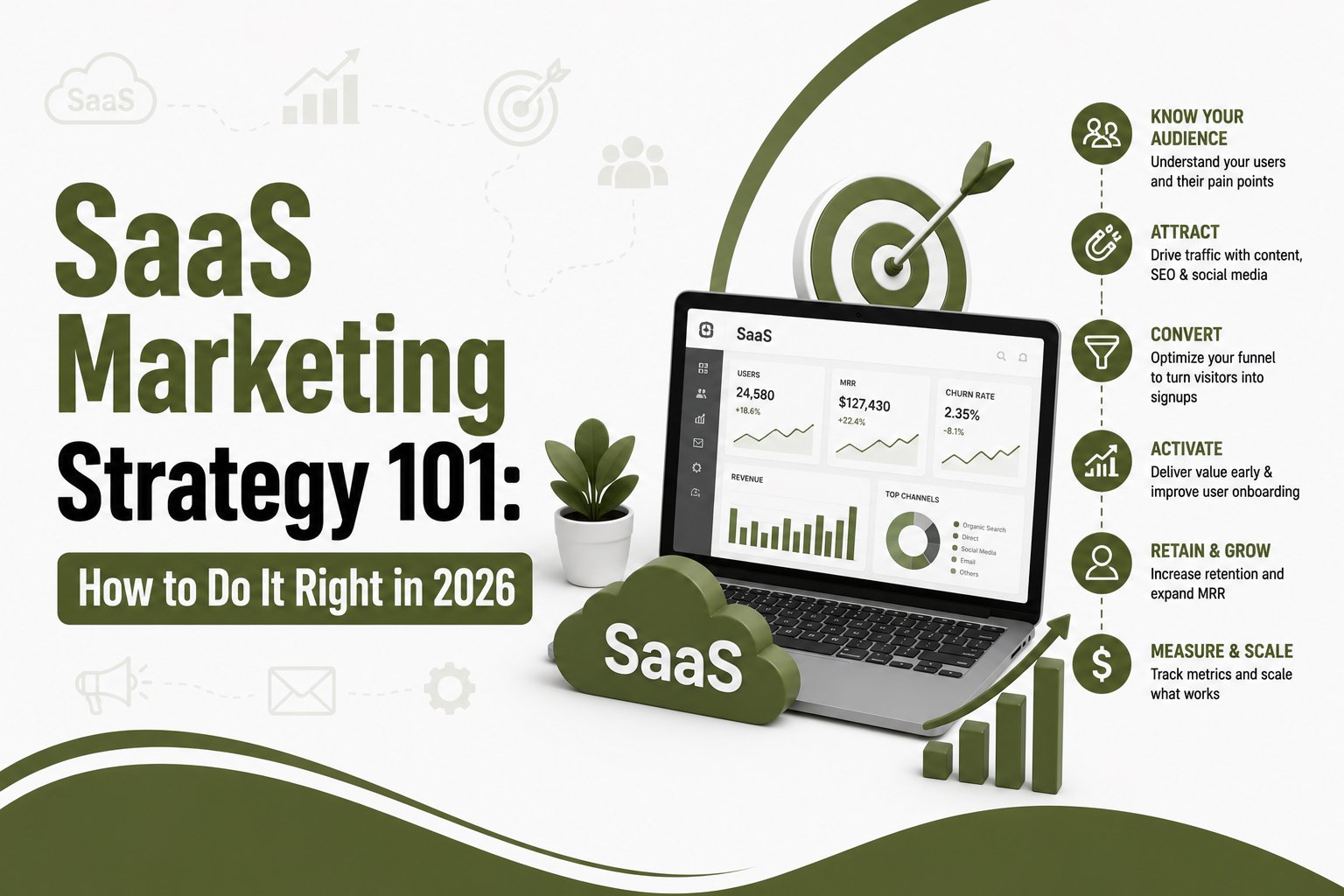
Learn how to build a winning SaaS marketing strategy — from SEO and content to PPC, ABM, and retention. Real tactics, metrics, and examples for 2026.
SaaS Marketing Strategy 101: How to Do It Right in 2026
Learn how to build a winning SaaS marketing strategy — from SEO and content to PPC, ABM, and retention. Real tactics, metrics, and examples for 2026.
If you’re building or marketing a SaaS product, you already know the problem: you’re selling something nobody can hold, touch, or try on. Your buyer can’t walk into a store and pick it off a shelf. They have to trust that your software will actually solve their problem — often before they’ve even spoken to your sales team. This is exactly why a solid SaaS marketing approach looks so different from marketing a physical product.
That’s what makes SaaS marketing such a different game from traditional product marketing. It’s not a one-time sale. It’s not a simple transaction. It’s a long-term relationship that starts with a click and (if you do it right) turns into years of recurring revenue.
In this guide, we’ll break down exactly what a SaaS marketing strategy looks like in 2026 — the channels that actually move the needle, the frameworks top SaaS companies use, and the metrics you should be watching every single week. Whether you’re a solo founder trying to get your first hundred customers or a marketing lead at a growing company trying to scale past your first million in revenue, the fundamentals in this guide will apply. We’ll also look at the tools and funnel structure that make a SaaS marketing strategy easier to execute and measure day to day.
01What Is SaaS Marketing?
SaaS marketing is the process of promoting cloud-based, subscription software to attract, convert, and retain customers over the long term. Unlike traditional marketing, which often focuses on a single purchase decision, SaaS marketing has to keep proving value month after month — because customers can cancel anytime.
At its core, SaaS marketing blends:
- Demand generation – building awareness and interest before people are ready to buy
- Lead generation – capturing and nurturing potential customers
- Product marketing – communicating features, benefits, and positioning
- Customer marketing – keeping existing users engaged so they don’t churn
Get any one of these wrong, and you either run out of new customers or leak the ones you already have.
02Why SaaS Marketing Is Different From Regular Marketing
Before jumping into tactics, it’s worth understanding why SaaS marketing needs its own playbook:
Understanding these differences is the foundation for every SaaS marketing strategy you build from here on.
03Core Elements of a Winning SaaS Marketing Strategy
1.Build a Clear Ideal Customer Profile (ICP)
Nothing in your strategy works if you’re talking to the wrong audience. Before writing a single blog post or ad, define:
- Who has the problem your software solves
- What their budget, company size, and industry look like
- Who the actual decision-maker is (often different from the end user)
- What triggers them to start looking for a solution
For example, a project management SaaS might discover its best customers aren’t solo freelancers but mid-sized agencies with 10-50 employees who are already juggling multiple spreadsheets and Slack channels to stay organized. Once you know that, every landing page headline, ad, and case study can speak directly to that specific pain point instead of trying to appeal to everyone at once.
A sharp ICP means every piece of content, ad, and email actually resonates instead of getting ignored — and it’s the single biggest factor that makes or breaks any SaaS marketing plan.
2.Invest in SEO and Content Marketing
Organic search remains one of the most cost-effective ways to bring in qualified SaaS leads, because it targets people who are already searching for a solution. In fact, SEO is often the backbone of an effective SaaS marketing strategy, since it keeps generating leads long after the content is published.
A solid SaaS content strategy usually includes:
- Educational blog content that answers the questions your ICP is already searching for
- Comparison and alternative pages (“X vs Y”) for buyers in the evaluation stage
- Use-case and industry pages that show your product solving specific problems
- Free tools, templates, or calculators that attract links and repeat visits
- Glossaries and how-to guides that build topical authority around your niche
The key is matching content to search intent at every funnel stage — awareness, consideration, and decision — rather than only writing about your product.
Keyword research should sit at the center of this effort. Start by mapping out the questions your ICP types into Google at each stage of their journey — from broad “what is” questions early on, to specific “best tool for X” and “[competitor] alternative” searches closer to the buying decision. Prioritize keywords that show genuine buying intent over ones that simply get high search volume, since a smaller audience of ready-to-buy searchers is worth more than a large audience just browsing.
3.Use Product-Led Growth (Free Trials & Freemium)
Letting people try before they buy removes a huge amount of friction from the SaaS buying decision. Two common models:
- Free trial – full or near-full access for a limited time
- Freemium – a permanently free tier with limited features, encouraging upgrades as needs grow
Whichever you choose, make it painless to start and easy to see value quickly — the faster someone hits their “aha moment,” the more likely they are to convert. Product-led growth has become one of the most talked-about SaaS marketing trends because it lets the product do part of the selling for you.
4.Run Targeted Paid Campaigns
Organic growth takes time, so most SaaS companies pair it with paid channels:
- Search ads (PPC) to capture high-intent keyword searches
- LinkedIn and social ads to reach specific job titles, industries, and company sizes
- Retargeting campaigns for visitors who didn’t convert the first time
Paid works best when it’s tightly targeted and tested constantly — small budgets thrown at broad audiences rarely perform well in B2B SaaS marketing.
5.Consider Account-Based Marketing (ABM)
For SaaS companies selling higher-priced products to a smaller pool of ideal accounts, ABM can outperform broad demand generation. Many B2B teams treat ABM as a natural extension of their SaaS marketing strategy once they know exactly which accounts are worth the extra investment. Instead of casting a wide net, you identify your best-fit accounts and build personalized campaigns — content, ads, and outreach — specifically for them, often coordinating closely with sales.
6.Lean on Referrals, Reviews, and Influencers
Buyers trust other buyers far more than they trust your ad copy, which is why word-of-mouth remains such an underrated part of SaaS marketing. Strengthen this channel by:
- Building a referral program that rewards both the referrer and the new customer
- Actively collecting reviews on third-party sites, since prospects rely heavily on social proof during evaluation
- Partnering with niche influencers or industry experts who already have your ICP’s attention and trust
7.Don’t Neglect Email and Lifecycle Marketing
Email remains one of the highest-ROI channels for SaaS because it nurtures leads through a long sales cycle and keeps existing customers engaged. Segment your email marketing by lifecycle stage:
- Onboarding sequences for new sign-ups
- Educational nurture emails for trial users
- Feature announcements and upsell prompts for existing customers
- Win-back campaigns for users who’ve gone quiet
8.Make Retention a Marketing Priority
In SaaS, marketing doesn’t stop once someone becomes a customer. Because revenue is recurring, keeping customers engaged and reminding them of your product’s value directly protects your bottom line — and it’s a part of SaaS marketing that too many teams overlook. This means:
- Regularly promoting new features and updates
- Sharing customer success stories that show ongoing value
- Monitoring usage data to spot at-risk accounts early
- Building a genuine community around your product
- Running quarterly business reviews or check-ins with high-value accounts to reinforce ROI
- Creating a customer advocacy program that turns happy users into case studies and referral sources
Marketing and customer success teams should work closely together here. Marketing often has the best storytelling skills and channels to amplify a customer’s success, while customer success has the closest relationship with the account and the earliest warning signs of churn risk. Combining the two turns retention into an active, ongoing part of your SaaS marketing strategy rather than an afterthought handled solely by support.
04Mapping Out Your SaaS Marketing Funnel
It helps to think of your SaaS marketing strategy as a funnel with three broad stages, each requiring a different type of content and messaging:
A common mistake is pouring all your budget into bottom-of-funnel tactics like ads and demos while ignoring the top of the funnel. Without a steady stream of new, educated prospects entering at the top, your bottom-of-funnel efforts eventually run dry.
05Essential Tools for Executing Your SaaS Marketing Strategy
You don’t need dozens of tools to run an effective SaaS marketing strategy, but a few categories are worth investing in early:
Choose tools that integrate well with each other — disconnected data across five different platforms makes it much harder to see the full picture of what’s actually working.
06Metrics That Actually Matter in SaaS Marketing
Tracking the right numbers tells you whether your SaaS marketing strategy is working — or quietly failing. The metrics worth watching closely include:
A healthy SaaS business generally wants LTV to be several times higher than CAC, and churn as low as possible — since retaining a customer is almost always cheaper than acquiring a new one.
07Common SaaS Marketing Mistakes to Avoid
Even a well-planned SaaS marketing strategy can fall flat if these common mistakes creep in:
08Frequently Asked Questions
There’s No Single “Hack” That Makes SaaS Marketing Work
It’s the combination of a clear ICP, valuable content, smart paid campaigns, and a genuine focus on keeping customers happy long after they sign up. Start with one or two channels you can execute well, track your metrics honestly, and expand as you learn what actually drives growth for your product. Whether you’re just starting out or refining an existing SaaS marketing strategy, consistency across these channels is what compounds into long-term growth.