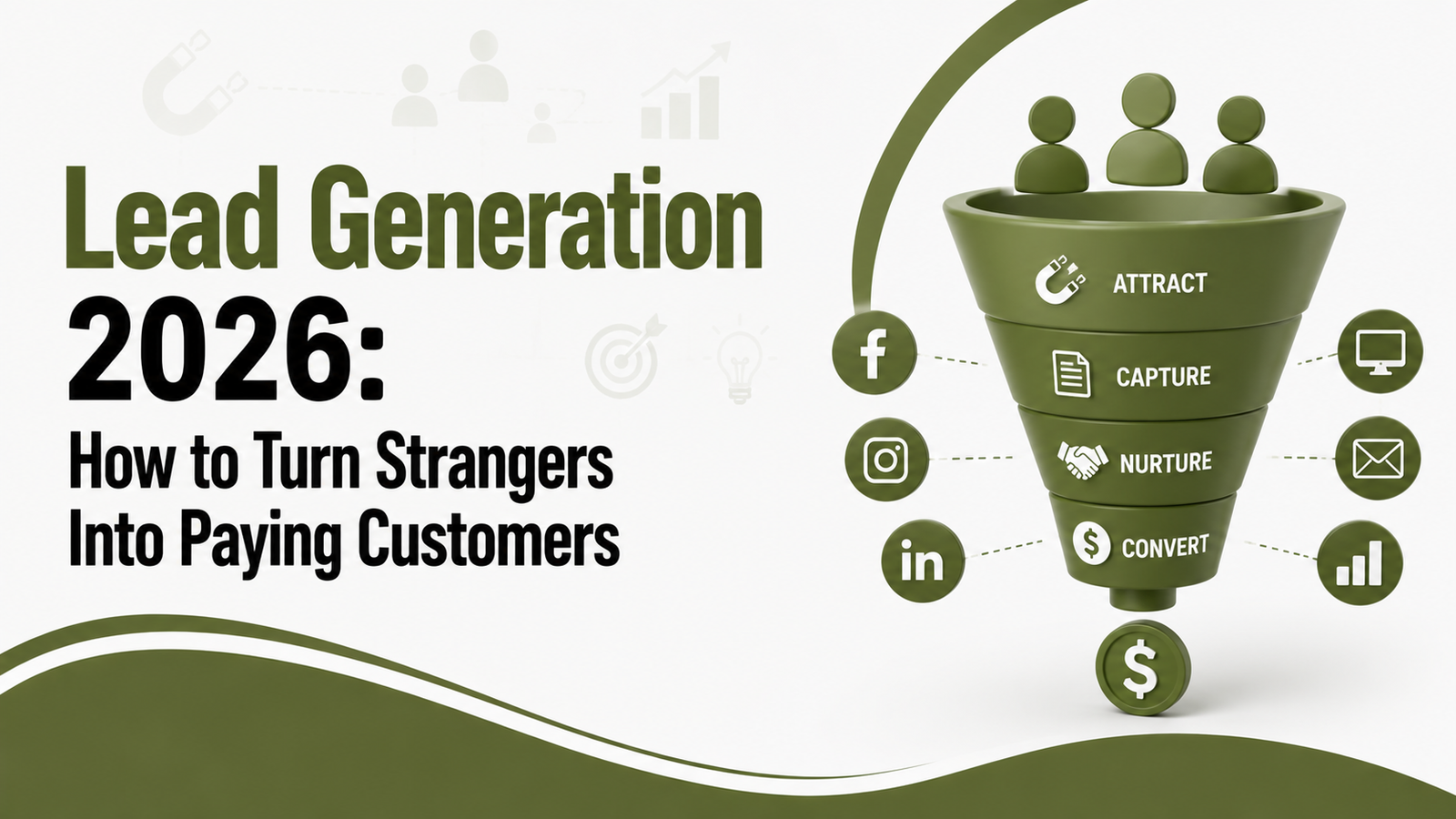
If you’ve ever stared at your CRM wondering why you have hundreds of “leads” but almost no actual sales conversations happening, you’re not alone. This is probably the single most common frustration in B2B marketing right now — and it’s exactly why Lead Generation 2026 looks so different from the strategies that worked even a couple of years ago.
Lead Generation 2026 — From Strangers To Paying Customers
Everyone’s chasing volume, everyone’s collecting email addresses, and yet somehow the pipeline still feels dry when it’s time to close deals. Here’s the uncomfortable truth: most of what passed for lead generation a few years ago simply doesn’t work the same way anymore. Buyers have changed — they research on their own terms, they ignore generic pitches instantly, and they’ve gotten really good at spotting a copy-paste outreach message from a mile away.
AI has quietly rewired how people search for solutions, how they compare vendors, and even how they decide who to trust before a human sales rep ever gets involved. That’s exactly why Lead Generation 2026 demands a completely different playbook.
01What Lead Generation 2026 Actually Means
Let’s get one thing straight first. Lead generation isn’t just “collecting emails” anymore, and honestly, it never should have been treated that way. At its core, Lead Generation 2026 is the process of attracting the right people, earning enough trust that they willingly share their information or engage with you, and then guiding them toward becoming a customer.
Buyers today complete most of their research anonymously — often close to 70% of the buying journey happens before anyone from your company even knows a prospect exists. They’re reading reviews, comparing you against competitors, asking AI tools like ChatGPT or Perplexity for recommendations, and quietly building an opinion of your brand long before they fill out a “Contact Us” form.
In Lead Generation 2026, the approach has shifted from “capture and nurture” to “identify and accelerate” — spotting genuine buying signals and reaching out at exactly the right moment with something genuinely relevant.
02Why The Old Lead Generation Playbook Is Breaking Down
A few things have converged to make traditional lead generation tactics less effective heading into 2026:
!
Inboxes and Feeds Are Saturated
Everyone is sending cold emails, everyone is running LinkedIn outreach campaigns, and generic templated messages get ignored — or worse, reported — almost instantly.
!
AI Search Has Changed Discovery
Buyers are increasingly asking AI assistants for recommendations instead of typing queries into Google. If your brand isn’t showing up in AI-generated answers, you’re invisible at the exact moment someone is deciding who to consider.
!
Lead Quality Is the Real Bottleneck
Businesses can hit their monthly lead targets on paper and still miss revenue goals because most of those contacts were never truly sales-ready.
!
Attribution Has Gotten Murkier
Buyers move across private communities, Slack groups, newsletters, and peer conversations that no analytics tool can fully track. This “dark social” activity influences purchase decisions in ways traditional attribution models can’t capture.
None of this means lead generation is dead. It means the rules have changed — and the businesses that adapt fastest to Lead Generation 2026 are the ones pulling ahead.
03The Data Behind Lead Generation 2026
Numbers tell the story better than opinions do. Here’s a quick reality check on where Lead Generation 2026 actually stands:
📈
Customer acquisition cost has climbed sharply, making brute-force outbound more expensive than ever.
📝
Content-driven strategies generate several times more leads than paid tactics — at a fraction of the cost per lead.
💼
LinkedIn is responsible for the overwhelming majority of B2B social leads globally.
🎥
Webinars frequently produce the highest-quality leads at a noticeably lower cost per lead than paid search.
🤖
AI adopters report more sales-ready leads and considerably lower customer acquisition costs than manual teams.
⚡
Prospects contacted within the first few minutes of showing interest are dramatically more likely to convert.
The pattern is clear: in Lead Generation 2026, quality beats quantity, speed beats delay, and channels built on trust consistently outperform pure interruption-based advertising.
04The Lead Generation 2026 Journey From Stranger to Customer
Before jumping into channels and tactics, it helps to zoom out and look at the actual path a stranger takes on their way to becoming a paying customer.
The Buyer Journey — Awareness to Loyalty
1
Awareness
A prospect first encounters your brand through content, a social post, a search result, or an AI-generated answer. At this stage, anything that feels like a hard sell will backfire.
2
Interest
They engage further — reading a blog post, following your company page, downloading a resource, or attending a webinar. This is where you earn permission to keep talking to them.
3
Consideration
Now they’re comparing you against alternatives. This is where case studies, reviews, comparison content, and social proof do the heavy lifting.
4
Conversion
They take the action that turns them into a lead or a customer — booking a call, starting a trial, or requesting a quote.
5
Loyalty & Advocacy
Often overlooked, but arguably the most valuable stage. A happy customer who refers others or leaves a strong review is one of the cheapest and most trusted lead sources you’ll ever have.
057 Lead Generation 2026 Channels That Actually Work
There’s no shortage of channels you could theoretically use, but only a handful consistently deliver results. Here’s what’s actually working right now in Lead Generation 2026.
01
SEO and Content Marketing
Search-driven content remains one of the most cost-efficient lead sources. The twist for Lead Generation 2026 is that you’re optimizing not just for Google’s blue links, but for how AI tools like ChatGPT, Perplexity, and Google’s AI Overviews summarize and cite your content — often called answer engine optimization.
02
LinkedIn and Social Selling
LinkedIn continues to generate the bulk of B2B social leads. Intent signals like job changes, company growth, or content engagement from specific people at your target accounts let you reach out at the moment someone is actually receptive.
03
Email Marketing (Still Not Dead)
Despite being declared “dead” every year for the past decade, email remains one of the most widely used and cost-effective tools available. The difference now is personalization and timing — well-timed, relevant, segmented emails still get opened and replied to.
04
Webinars and Virtual Events
Webinars have become one of the highest-converting lead sources — anyone willing to spend thirty or sixty minutes learning about a topic is self-selecting as a genuinely interested prospect. The lead quality tends to be noticeably higher than most other channels.
05
AI Chatbots and Conversational Capture
Static contact forms are quickly becoming a relic. AI-powered chatbots can hold genuine conversations, ask qualifying questions, and route a hot prospect straight to a human rep — all without forcing someone to fill out a ten-field form.
06
Interactive Content
Quizzes, calculators, assessments, and interactive tools consistently outperform static content. Buyers tend to prefer participating over passively reading, and these formats naturally create a moment where exchanging an email address for a personalized result feels like a fair trade.
07
Account-Based Marketing (ABM)
ABM has moved from being a niche enterprise tactic to something companies of almost any size can run, largely thanks to AI making account research, personalization, and timing far less manual. Instead of one generic campaign aimed at thousands of random contacts, ABM focuses on a defined list of high-value accounts.
07Inbound vs Outbound: Which One Actually Wins?
This debate has been going on forever, and the honest answer is: neither one wins alone anymore. Relying purely on inbound means you’re only capturing the small slice of buyers who are already actively searching. Relying purely on outbound means constantly fighting an uphill battle against low response rates and increasingly sensitive spam filters.
The strategy that’s actually working for most companies in Lead Generation 2026 blends both. Content and SEO build long-term, compounding visibility. Outbound and ABM accelerate engagement with the accounts that matter most, right now.
08How AI Is Changing Lead Generation 2026
AI has moved well past being a tool for drafting a few email templates. It’s increasingly handling entire chunks of the Lead Generation 2026 process on its own:

AI Is Reshaping Every Stage Of Lead Generation
→
Research and Enrichment
Automatically pulling firmographic and behavioral data on a prospect before a rep even opens their inbox.
→
Lead Scoring
Layering intent signals (pricing page visits, recent leadership changes) on top of traditional firmographic fit to flag who’s actually worth prioritizing.
→
Personalization at Scale
Generating messaging tailored to a specific role, industry, or pain point — rather than one generic template sent to everyone.
→
Instant Response
Chatbots and AI agents that engage a website visitor the moment they show interest, instead of making them wait hours for a human reply.
Companies leaning into this well are seeing meaningfully shorter sales cycles and noticeably better lead quality. But AI without good data and a clear strategy just automates mediocrity faster.
09Common Lead Generation 2026 Mistakes That Quietly Kill Results
Even with the best tools and channels, plenty of teams sabotage their own pipeline without realizing it:
✕
Chasing Volume Over Fit
A thousand unqualified leads will always underperform a hundred well-targeted ones.
✕
Slow Follow-Up
Letting a hot lead sit for even a few hours dramatically reduces the odds of ever hearing back from them.
✕
No Real Personalization
Swapping in a first name isn’t personalization — referencing something specific and relevant to that person’s situation is.
✕
Treating Every Channel in Isolation
A prospect who gets a random cold email, a disconnected LinkedIn message, and an unrelated retargeting ad doesn’t feel like they’re talking to one coherent brand.
✕
Ignoring the Marketing-Sales Handoff
If marketing and sales don’t agree on what counts as a “qualified” lead, good prospects get lost in the gap between the two teams.
10How to Build a Lead Generation 2026 Strategy
If you’re starting from scratch or rebuilding what you already have, here’s a practical Lead Generation 2026 sequence to follow:
1
Get Painfully Specific About Your Ideal Customer
Not just industry and company size — the actual pain points, triggers, and buying behavior that separate a great-fit customer from a mediocre one.
2
Audit Where Your Current Leads Actually Come From
Map every stage from first touch to closed deal, and be honest about where prospects are dropping off.
3
Pick Two or Three Channels and Go Deep, Not Wide
Trying to do everything at once usually means doing nothing particularly well.
4
Build Content Around Real Buyer Questions
Not just what you want to say about your product — what your buyers are actually searching for and asking.
5
Put a Lead Scoring System in Place
So sales isn’t wasting time on prospects who were never going to convert.
6
Automate the Repetitive Parts
But keep a human involved wherever real relationship-building matters.
7
Review and Adjust Constantly
Treat your Lead Generation 2026 strategy as something you revisit every couple of weeks, not something you set once a year and forget.
11Lead Generation 2026 Metrics That Actually Matter
Vanity metrics like “total leads generated” look nice in a report but rarely tell you much about business health. Focus instead on:
Cost Per Qualified Lead
Not just cost per lead — the cost of leads that were actually worth pursuing.
Lead-to-Opportunity Rate
How many of your leads were actually worth pursuing by the sales team.
Speed to First Response
This alone can make or break conversion odds — every minute matters.
Pipeline Contribution
How much actual revenue potential your Lead Gen 2026 efforts are creating.
CAC vs Lifetime Value
Whether your Lead Generation 2026 engine is actually profitable, not just busy.
Channel Attribution
Which sources are actually driving qualified deals — not just top-of-funnel noise.
12Frequently Asked Questions
What is the most effective Lead Generation 2026 channel?+
There isn’t a single “best” channel for every business — it depends on your audience. That said, SEO and content marketing, LinkedIn, and webinars consistently rank among the highest-performing and most cost-efficient channels for B2B companies right now.
Is cold email still worth doing in Lead Generation 2026?+
Yes, but only when it’s personalized, well-timed, and backed by real research on the prospect. Generic, mass-blasted cold email has become far less effective as inboxes get more crowded and spam filters get smarter.
How is AI changing Lead Generation 2026?+
AI is helping teams identify high-intent prospects faster, personalize outreach at scale, respond to inbound interest instantly through chatbots, and score leads more accurately using behavioral and firmographic data together.
What’s the difference between a lead and a qualified lead?+
A lead is simply someone who’s shown some level of interest, like filling out a form. A qualified lead is someone who actually fits your ideal customer profile and has shown genuine buying intent — not just casual curiosity.
How long does it take to see results from a Lead Generation 2026 strategy?+
Outbound and paid channels can produce results within weeks, while SEO and content marketing typically take a few months to build momentum but tend to compound and outperform paid channels over the long run.
● Final Thoughts
Earn Attention. Prove You Understand. Be Present When They’re Ready.
Turning a total stranger into a paying customer was never going to be a simple, one-step process, and Lead Generation 2026 has arguably become more nuanced than ever. But the businesses succeeding right now aren’t necessarily the ones with the biggest budgets — they’re the ones being genuinely helpful, showing up consistently in the places their buyers already spend time, and using AI to move faster without losing the human touch that actually builds trust.
Lead Generation 2026 isn’t about tricking someone into giving you their email address. It’s about earning attention, proving you understand their problem, and being present the moment they’re ready to act. Get that right, and the “strangers to customers” part takes care of itself.
Lead Generation
SEO & Content
LinkedIn
AI Prospecting
ABM
Email Marketing